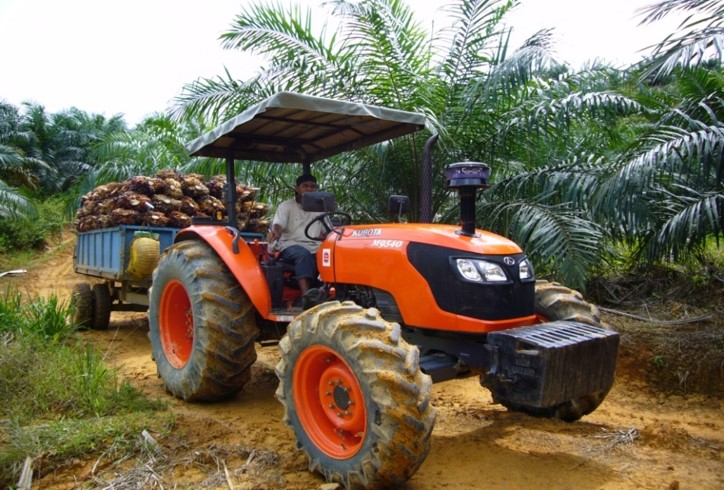
You bought the tractor from a neighbour. Or inherited it from a relative who farmed paddy in Kedah for twenty years. Or you picked it up second-hand with no manual, a faded decal, and a persistent hydraulic leak that needs fixing. The first question is always the same: what model is this exactly — and where do I find the parts?
This guide walks through the exact steps we use when we take in a customer call for an older Kubota. It sounds simple, but with a fleet of tens of thousands of Kubota tractors in Malaysia — many of them over 15 years old — the wrong part number is an expensive mistake.
Step 1: Find the Model Plate (or What's Left of It)
Every Kubota tractor has a model and serial number plate, usually located in one of three places depending on the series:
- L series (compact/mid, 30–50HP): Left side of the main frame, just ahead of the front axle, or on the instrument panel housing.
- M series (heavy-duty, 60–110HP): Right side of the chassis near the transmission housing, or on a plate under the bonnet near the engine.
- B series (compact, under 30HP): Dashboard panel or near the front bonnet latch.
The plate typically shows two things: the model code (e.g., L4400DV, M9540DT) and a serial number (a 5–7 digit number starting with the model prefix).
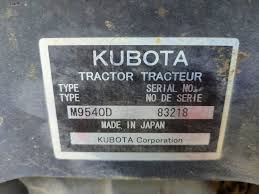
Tip: If the plate is missing or illegible — common on tractors over 15 years old — move to Step 2.
Step 2: Decode the Model Code Yourself
Kubota model codes follow a consistent pattern. Once you learn to read them, you can often identify the tractor from memory or a quick look.
| Code element | What it means | Example |
|---|---|---|
| Letter prefix | Series (B = compact, L = utility, M = heavy) | L4400 |
| Number | Approximate engine HP × 100 | L4400 = ~44HP |
| Last two digits | Model revision/generation | L4400 |
| Suffix letters | Transmission/drive type | L4400DV = dual-velocity 4WD |
Common suffixes you'll see in Malaysia:
- DT = diesel, 4WD (dry-type clutch)
- DV = dual-velocity transmission, 4WD
- SU = shuttle transmission, utility
- DHV = 4WD, high-clearance variant
So M9540DT = M series, ~95HP, 4WD, 40th revision in that line.
Step 3: Use the Engine Number as a Backup
If the model plate is gone, the engine serial number is your next best option. It's stamped directly into the engine block (usually the top or right-hand side), and it will give you the engine model code — which is often enough to identify the tractor series and compatible parts.
Common Kubota engine codes found in older Malaysian tractors:
| Engine code | Found in tractor models |
|---|---|
| V3800-DI | M9000, M9540 (older gen) |
| V2403-M | L4400, L4200, L3800 |
| V2203 | L3408, L3608, L3000 |
| D1503 | L3200, L2900, L3010 |
| D1105 | B2920, B3200, B2320 |
| V6108 | M108S, M110 |
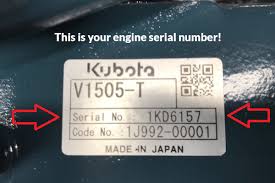
With the engine code, we can usually cross-reference the full parts catalogue even without the model plate.
Step 4: Cross-Reference the Parts Number
Kubota uses a consistent parts numbering system across models. Many parts — gaskets, seals, bearings, hydraulic components — are shared across multiple generations and series. This is particularly useful for older models where genuine Kubota parts are discontinued.
The general parts number format is:
XXXXX-YYYYY where the first five digits often indicate the component family and the last five indicate the specific variant.
For example:
TC422-16800(starter motor) fits: L3218, L3408, L4018, L4508, L5018 — five different models, one part.TD030-12010(bevel gear) fits: L3408, L3608, L4018, L4400, L4508, L4708, L5018, M5000.
This cross-compatibility is why we can still supply parts for tractors that are 20+ years old — the components often overlap with models that were made much more recently.
Step 5: When You Still Can't Figure It Out
If you've exhausted the above steps, here's what else works:
- Measure the tractor. Kubota publishes dimensional specs for all models. Wheelbase, overall length, and the shape of the bonnet/hood are often enough to narrow it down to two or three candidates.
- Check the hydraulic system. Older Kubota L series used an open-centre hydraulic system; newer ones shifted to closed-centre. This matters for parts compatibility.
- WhatsApp us a photo. We keep records of the most common older Kubota models sold in Malaysia going back to the 1990s. Send us a photo of the engine and the left side of the frame — nine times out of ten we can identify it within a few minutes.
The Bottom Line
Identifying an old Kubota tractor in Malaysia doesn't have to be a guessing game. The model plate, serial number, and engine code are three independent ways to pin down exactly what you have. And once you know the model, the parts cross-reference system means you often have more options than you'd expect — including aftermarket alternatives that cost a fraction of genuine parts.
We specialise in exactly this: sourcing parts for older and hard-to-find Kubota models that mainstream dealers no longer stock. Whether your tractor is a 2005 L3408, a 2000 M9000, or a 1995 B5200, we can help.