John Deere is the most recognised tractor brand in the world. In Malaysia, its green-and-yellow machines are a fixture on paddy estates in Kedah and Kelantan, oil palm plantations in Johor and Sabah, and increasingly on smallholder farms that have moved up from compact Kubota models. The 5075E, 5310, and 6J series account for the majority of the fleet.
The problem most Malaysian JD owners run into is this: the authorised John Deere dealer network here is thinner than Kubota's. Outside of Kuala Lumpur and a handful of state capitals, dealer support can mean long waits and prices that reflect low local competition. And for models like the 5310 and 5403 — tractors that are now 15–20 years old — parts are progressively harder to source through official channels.
This guide covers the most important things to know when sourcing John Deere parts in Malaysia: engine codes, common failures, and how to get what you need when the dealer says it's not available.
Know Your Engine Before You Order
The single biggest mistake in JD parts ordering is not knowing which engine is fitted. John Deere uses two completely different engine families across its utility tractor range in Malaysia:
PowerTech 3029 (3.0L, 3-cylinder)
Used in: 5055E, 5075E, 5310, 5403
The 3029 comes in several variants:
- 3029D — naturally aspirated, found in older 5310 and 5403 models
- 3029T — turbocharged version of the same block
- 3029TF / DF — updated emissions-era variant used in newer 5055E and 5075E
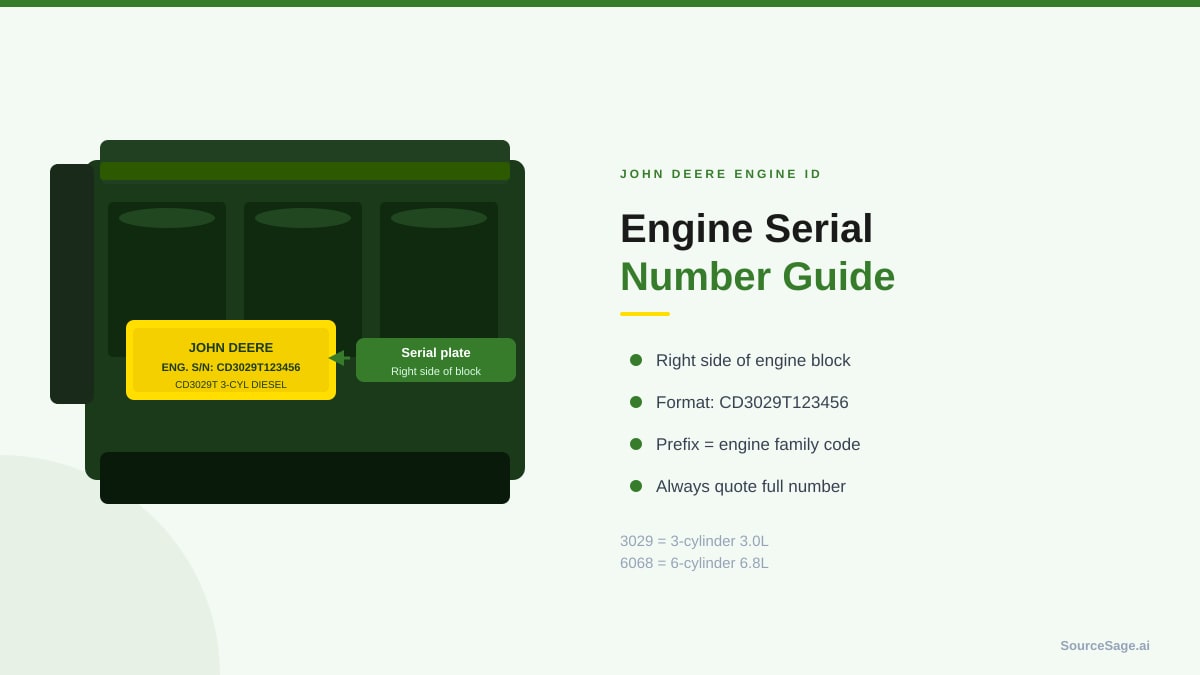
The D and TF variants share the same block architecture but have different fuel injection systems, turbocharger specifications, and engine management. Overhaul kits, injectors, and cylinder heads are not interchangeable between the D and TF variants. Always use the engine serial number — stamped on the block near the alternator — to confirm which version you have.
PowerTech 6068 (6.8L, 6-cylinder)
Used in: 6125J, 6128J
The 6068 is a substantially larger engine used in the 6J series plantation and large-farm tractors. Nothing from the 3029 family fits the 6068. If you have a 6J series tractor, confirm this engine before ordering any internal components.
PowerTech 4045 (4.5L, 4-cylinder)
The John Deere 5415 uses a John Deere 4045D (4.5L, 4-cylinder) naturally aspirated engine, while the 6110J uses a John Deere 4045 PowerTech (Turbocharged, 4.5L, 4-cylinder).
Citation: John Deere 5415 / 6110J specification; TractorData
The Most Common John Deere Failures in Malaysia
1. Injector Nozzle Wear
Fuel quality in Malaysia varies significantly between regions. Lower-grade diesel — common in rural areas — accelerates injector wear. Symptoms: black smoke under load, rough idle, hard starting when warm.
The 3029 uses Stanadyne fuel injection on most variants. Stanadyne is an American OEM supplier — their injector components are available through specialist channels and are considered genuine quality, not aftermarket.
Average replacement interval in Malaysian conditions: 3,000–5,000 hours, often earlier with variable fuel quality.
2. Cooling System Failures
The 5075E and 5310 run the engine fairly hard in paddy field conditions — constant low-speed draft work generates significant heat. Radiator cores block with debris; thermostats fail open or closed; water pump seals leak slowly until the situation becomes acute.
Watch for: rising operating temperature gauge, coolant loss without visible external leak (often the water pump weep hole), white smoke on startup (head gasket starting to fail).
3. Hydraulic Lift Weakness
The open-centre hydraulic system on older 5310 and 5403 models is less sophisticated than modern closed-centre systems. The hydraulic pump wears over time, reducing lift capacity. Control valve O-rings harden and leak. Draft control becomes unreliable.
This is a gradual failure — most operators notice it first when the 3-point hitch won't hold heavy implements at full height.
4. Clutch Wear (Manual Transmission Models)
The HST (hydrostatic) models avoid this entirely, but the manual and PowrReverser variants see clutch wear, particularly from operators who ride the clutch in soft paddy soil conditions. Clutch disc, pressure plate, and release bearing are the usual replacement set.
5. Electrical Gremlins (Older Models)
The 5310 and 5403 use a relatively simple electrical system, but connector corrosion — accelerated by Malaysia's humidity — causes intermittent faults. Glow plug failures cause hard starting in older units. Temperature sender and oil pressure sender failures trigger false warning lights.
Genuine vs Aftermarket — What to Use Where
| Component | Recommendation |
|---|---|
| Injector nozzles | Stanadyne OEM (for US-system 3029) or Bosch equivalent |
| Fuel filter | Genuine JD or equivalent Baldwin/Fleetguard |
| Engine overhaul kit | Genuine JD for in-warranty; quality aftermarket (Mahle, Federal-Mogul) for older units |
| Cylinder head | Genuine JD recommended — aftermarket heads have variable quality |
| Hydraulic seals | Quality aftermarket acceptable if dimensions verified |
| Clutch disc | Quality aftermarket acceptable — verify friction material spec |
| Belts and hoses | Any quality brand matching spec (Gates, Dayco) |
The rule of thumb: use genuine or top-tier OEM-equivalent for anything inside the engine or managing fuel. Hydraulic seals, filters, and wear items can use quality aftermarket without meaningful performance difference.
Finding Parts When the Dealer Can't Help
John Deere Malaysia's dealer network services machines within the standard support window. For older models — 5310, 5403, 5415, and early 5075E — some parts are progressively discontinued from local stock.
When that happens, the sourcing path typically goes:
- Japan secondary market — Japan has a large JD presence through its agricultural machinery sector. Dismantled units yield genuine parts, often in excellent condition.
- OEM-compatible suppliers — For wear items (injectors, filters, seals), Stanadyne, Bosch, and Mahle supply parts to JD-compatible spec at lower cost than dealer pricing.
- Cross-model compatibility — Some 3029-series components fit across multiple JD models. A parts specialist can identify compatible equivalents when your specific part number is discontinued.