
The Kubota L4400 was one of the best-selling mid-range tractors in Malaysia through the 2000s and early 2010s. At 45 horsepower, 4WD, and with a dual-velocity transmission that worked well in both field and transport conditions, it hit a sweet spot for small and medium paddy farms that needed more power than a compact but couldn't justify an M-series.
There are still a significant number of old-generation Kubota L4400 and L4200 units working Malaysian fields — on top of the newer L4400DV units that continue to be sold today.
Where Is the L4400 Used in Malaysia?
The L4400 found its market in a specific gap: farms that needed more than a compact 30HP tractor but where an M-series was overkill or unaffordable. At 45HP with 4WD and a versatile dual-velocity transmission, it became the go-to tractor for:
Paddy farming (largest segment): The L4400DV dominated small-to-medium paddy plots of 5–20 acres across Kedah, Kelantan, and Perlis. Its size made it nimble enough for the tight turns of Malaysian paddy plots while the 45HP gave it enough grunt for rotary tilling of heavy wet soil. Many units sold through the government's MADA and KADA (Kemubu Agricultural Development Authority) subsidy programmes ended up as L4400s.
Mixed and vegetable farming: In Camerons Highlands, Fraser's Hill foothills, and parts of Johor and Selangor, the L4400 was popular for farm road construction, cover crop management, and general earthworks on terraced vegetable plots. The DV transmission's ability to hold very slow forward speeds made it well-suited for precision implement work.
Oil palm smallholders: In Johor, Pahang, and parts of Sabah, smaller oil palm operations (under 50 acres) used the L4400 for inter-row slashing (with a hydraulic brush cutter), fertiliser application support, and light road maintenance. It's not the ideal palm oil tractor — that role belongs to the M-series — but for smallholders who couldn't justify a 95HP machine, the L4400 worked.
Orchard and fruit farms: In Perak (pomelo, banana) and Johor (durian, rambutan), the L4400 compact footprint was an advantage. It could navigate between mature tree rows and handle the gentle slope work that characterises Malaysian orchard terrain.
Geographically, the old-generation L4400 units are most concentrated in Kedah, Kelantan, and Perak for paddy, with a secondary concentration in Johor and Pahang for mixed farming and palm smallholder use. This distribution matters for parts lead times — much of the installed base is in states where authorised Kubota dealer coverage thins out considerably.
The L4400 Family: Which Variant Do You Have?
The L4400 was sold in Malaysia in several configurations:
- L4400DT — Standard 4WD, 8-speed transmission (older spec)
- L4400DV — Dual-velocity 4WD, the most common version in Malaysia from 2005 onwards
- L4400HST — Hydrostatic transmission (uncommon in Malaysian market)
The DV variant is by far the most common. It has a distinctive dual-range selector that gives eight effective speeds in forward and reverse. If you have an L4400 from a Malaysian agricultural dealer post-2005, it's almost certainly a DV.
Parts vary slightly between DT and DV — the transmission internals are different — so confirming your variant matters when ordering.
L4400 Engine: The V2203
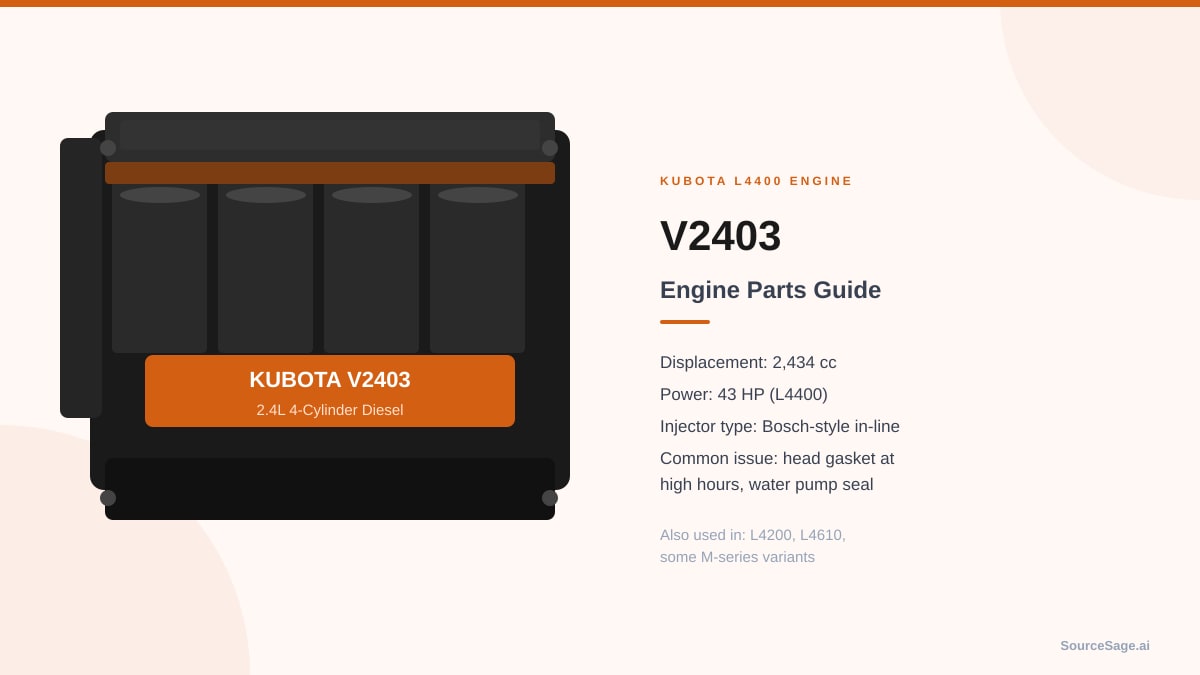
The L4400 is powered by the Kubota V2203 — a 2.2-litre, 4-cylinder naturally-aspirated diesel that is one of the most reliable engines Kubota has ever built. It's shared across the L-series family (L4200, L4400, some L4740 variants), which means excellent parts availability even for older units.
The V2203 is generally trouble-free up to 4,000–5,000 hours with regular oil changes. Beyond that, you'll start to see the common aging issues.
7 Common Problems on the Kubota L4400 in Malaysia
1. Hydraulic Lift Not Raising Fully (or Won't Hold)
This is the most common issue on L4400 tractors in the 8–15 year age range.
Causes (in order of likelihood):
- Hydraulic oil level low or oil badly degraded
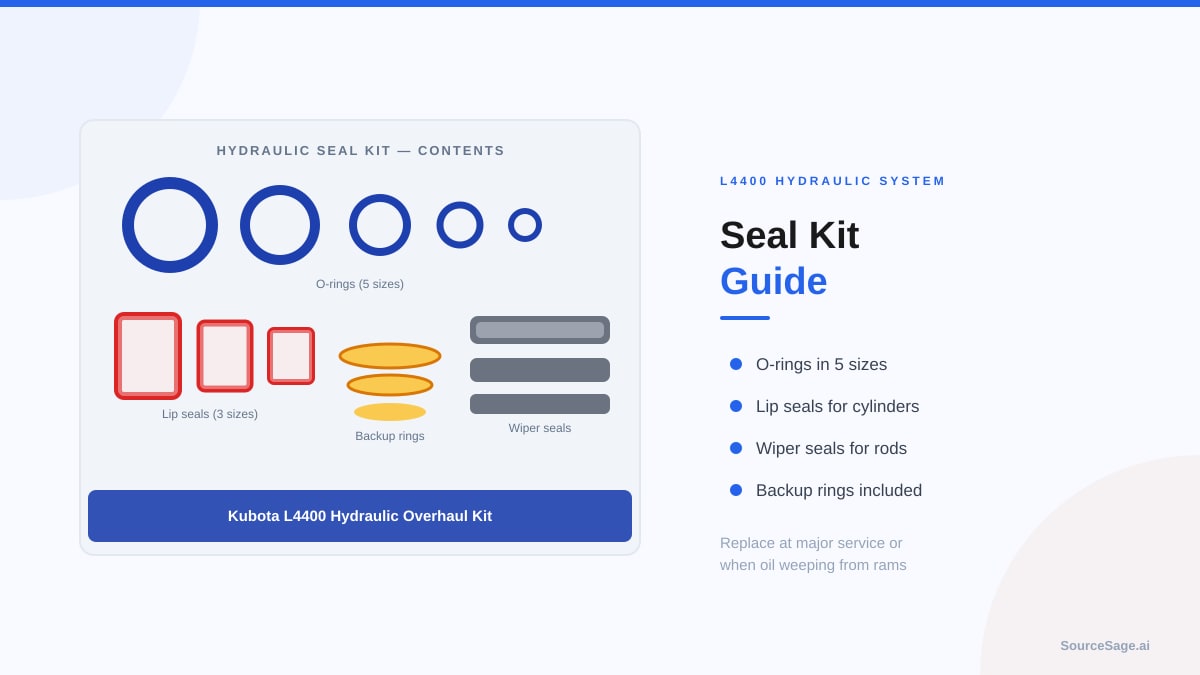
- External control valve O-ring seal failure
- Hydraulic pump wear reducing system pressure
- Internal cylinder seal failure
Diagnosis first: Check oil level and condition. Drain and refill with fresh Kubota UDT fluid before assuming anything is mechanically wrong — contaminated oil causes pressure loss that mimics pump failure.
Parts needed: O-ring and seal kit for the control valve (cheap, often fixes it), or pump seal kit if pressure test confirms low output.
2. PTO Not Engaging or Slipping
The L4400 PTO clutch is part of the main clutch assembly. After 10+ years of regular use, the clutch plate wears down and engagement becomes inconsistent.
What you'll notice: PTO engages but doesn't transmit full power under load, or disengages unexpectedly.
Parts needed: PTO clutch disc and pressure plate. These are available as a matched set. On the DV model, the clutch access requires removing the rear implement housing — a half-day job for a competent mechanic.
3. Transmission Grinding or Hard Gear Selection
The dual-velocity transmission on the L4400DV is robust but the synchroniser rings wear over time, particularly in the high/low range selector.
What you'll notice: Grinding when selecting gears, difficulty engaging the high/low range, or occasionally the transmission jumping out of a gear under load.
Parts needed: Synchroniser ring set for the affected range. In severe cases, the gear itself may be chipped and needs replacement. This is a more involved repair — transmission needs to come out.
4. Overheating
L4400 tractors in Malaysia overheat for one of three reasons:
- Radiator fins clogged with chaff or soil. This is the most common and easiest to fix — clean the radiator with compressed air or a careful water wash from the engine side out.
- Coolant level low or coolant contaminated. Check for milky oil (head gasket failure) or unexplained coolant loss.
- Thermostat stuck closed. Easy to diagnose, cheap to fix.
Parts needed: Thermostat (inexpensive — WhatsApp us for a current quote), or radiator flush kit. If it's a head gasket, the V2203 head gasket set is readily available.
5. Front Axle Wear and Steering Play
The L4400 front axle pivot and knuckle assemblies wear over time, giving the steering a vague, wandering feel. In severe cases you'll see the front wheels wobbling at speed.
Parts needed: Front axle pivot pin and bushes, steering knuckle bearing. Part numbers TA040-12530 (steer knuckle gear) and related bushing kits cover the L4400 and share with several other L-series models.
6. Fuel Consumption Increasing / Black Smoke
Black smoke on a naturally-aspirated diesel like the V2203 means one thing: the fuel:air ratio is wrong. Either too much fuel (injector dribbling/worn nozzle) or too little air (blocked air filter).
Check first: Air filter — replace if in doubt. Filters are cheap; troubleshooting is not.
If it persists: Injector nozzle testing. Worn or dribbling nozzles cause both black smoke and increased fuel consumption. Nozzle sets for the V2203 are available as aftermarket.
7. Electrical — Starting Issues and Alternator Failure
L4400 tractors of this vintage commonly develop intermittent starting issues caused by:
- Corroded battery terminals (clean and retighten — often that's all it is)
- Worn starter motor brushes
- Failed alternator
Parts needed: Starter motor brushes/rebuild kit or replacement starter, alternator or voltage regulator. The starter is a common unit shared with several L-series models.
Parts Cross-Compatibility for the L4400
Good news: the L4400 shares many parts with adjacent models. If you can't find a specific L4400 part, check compatibility with:
- L3800 — shares many hydraulic components (note: L3800 uses D1803 1.8L 3-cyl diesel — different engine family; engine parts not interchangeable)
- L4200 — predecessor model, significant overlap
- L4740DV — shares hydraulic and electrical components
We maintain a cross-reference list that often opens up more sourcing options than searching for L4400-specific parts alone.
Should You Keep Running Your L4400?
Almost always yes — if the base structure (frame, axle housings, engine block) is sound. The V2203 engine has a reputation for lasting 8,000+ hours with basic maintenance. The consumable parts we've described above are not indicative of a tractor that's worn out — they're normal lifecycle replacements on any machine that works hard.
The economic calculus is straightforward: a new Kubota L4400DV equivalent today costs significantly more than it did a decade ago. Keeping your existing machine well-maintained is usually the better financial decision for another 5–10 years of service.