
If you own a Kubota M9000 or the older-generation M9540, you own one of the most successful high-horsepower tractors ever sold in Malaysia. Between 2000 and 2014, these models dominated the heavy-duty paddy farming segment. They pulled transplanting rigs, ran rotary tillers, and handled combines in conditions that would sideline lesser machines.
They're also, at this point, 10 to 25 years old. And the parts question is becoming a pressing concern for a large number of owners.
This guide covers the most commonly needed M9000/M9540 parts, where failures typically occur, and how to make sure you're getting the right component — whether you go genuine, aftermarket, or used.
Quick Specs: M9000 vs Old-Gen M9540
| Spec | Kubota M9000 | Kubota M9540 (pre-2015) |
|---|---|---|
| Engine | V3300-TIE (92HP, 3.3L turbocharged) | V3800-DI-T (95HP, 3.8L turbocharged) |
| Transmission | 16F/16R (Synchro) | 24F/24R (Powershift optional) |
| Drive | 4WD | 4WD |
| Hydraulic capacity | 87.4 L/min | 64.3 L/min (pump) |
| Weight | ~3,450 kg | ~3,700 kg |
| Years sold in Malaysia | 1997–2005 | 2006–2013 |
The M9000 and M9540 share a significant number of drivetrain and hydraulic components, which is good news for parts sourcing — a large combined installed base means better aftermarket support.
How Many Are Still Running in Malaysia?
These tractors represent one of the largest segments of out-of-warranty, high-demand Kubota tractors in Malaysia — many are still working in paddy fields across the country.
Where are these tractors working?
The M9000 and M9540 are heavy-duty machines, and their use in Malaysia reflects that. The largest concentration is in the paddy farming states:
- Kedah and Perlis — the rice bowl of Malaysia. M-series tractors are the workhorses for deep soil preparation, heavy bund construction, and towing transplanting rigs and threshers. The wet, clay-heavy soil of the Muda Agricultural Development Authority (MADA) region demands the high torque that only a 78–95HP tractor can reliably deliver.
- Kelantan and Terengganu — significant paddy acreage, often with older equipment given the more fragmented farm ownership pattern in these states. This is where older M9000 units are particularly common.
- Perak — mixed paddy and horticultural use, including some deployment on larger vegetable plots and fruit farms where the M-series handles earthworks.
- Sabah and Sarawak — a smaller but meaningful segment: plantation support work on oil palm estates, particularly for road maintenance and drainage earthworks on smallholder palm plots. The M9540's high ground clearance variants were popular for inter-row work on younger palm stands.
- Selangor and Johor — lighter presence, mostly on mixed farms and for soil preparation on larger vegetable growing operations.
The implication for parts: these tractors are spread across the entire peninsula and East Malaysia, often far from any authorised Kubota dealer. When something fails in the middle of a paddy season in Pendang or a plantation track in Lahad Datu, the owner needs a supplier who can move quickly — which is exactly what we're set up to do.

The 8 Parts Most Commonly Replaced on M9000/M9540 in Malaysia
Based on common wear patterns on M9000/M9540 in Malaysian conditions, these are the components that fail most often:
1. Clutch Assembly (Main + PTO)
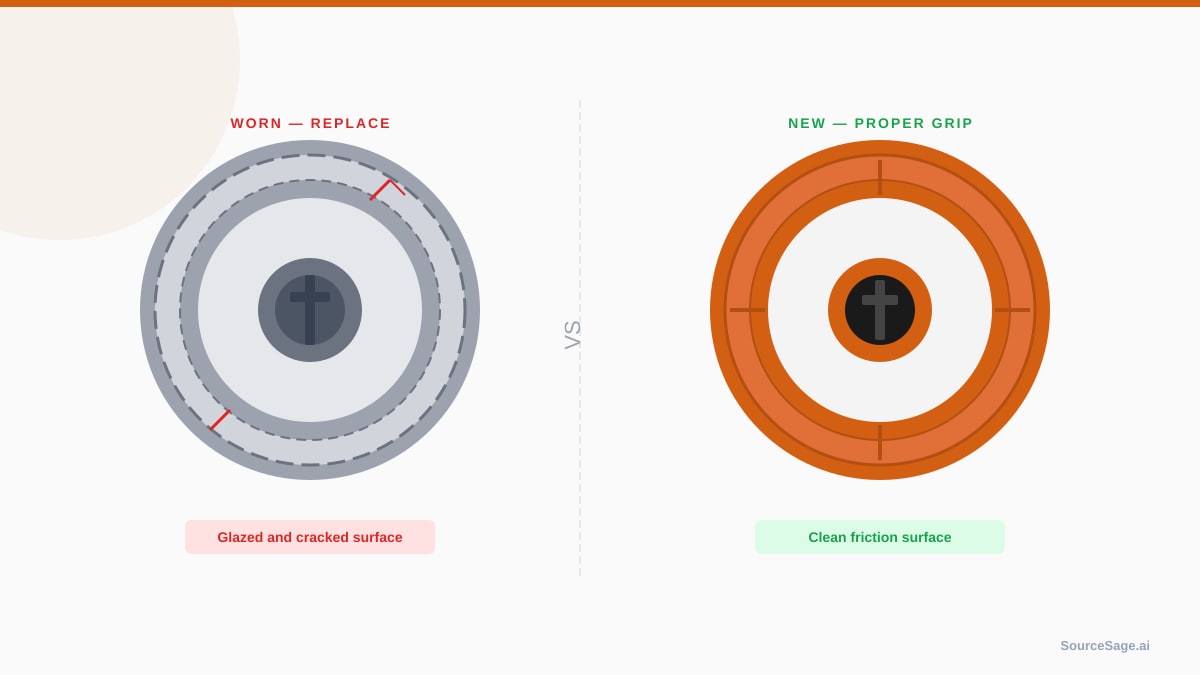
Why it fails: Malaysian paddy field conditions — wet, heavy soil, frequent engagement/disengagement on uneven ground — put extreme stress on clutch components. The main clutch disc typically shows wear after 1,500–2,500 hours in these conditions.
What to replace: Clutch disc, pressure plate, release bearing — usually as a set. The M9540DT uses a dual clutch (main + PTO) and both should be inspected when one shows wear.
Parts note: Aftermarket clutch assemblies from reputable Taiwan suppliers perform well in these conditions. Avoid low-cost Chinese imitations that use incorrect friction material hardness — they glazing or fade under heavy load.
2. Hydraulic Pump
Why it fails: Sediment and moisture contamination in the hydraulic oil is common in older machines. The pump seal kit fails first; if left untreated, it progresses to pump body wear.
What to replace: Start with the seal kit (cheaper, often solves the problem). If pressure is still low after resealing, the pump body or the priority valve may need replacement.
Parts note: Genuine Kubota hydraulic seal kits are still available for the M9000/M9540 platform. Aftermarket seal kits from Japanese-spec manufacturers are also acceptable.
3. Engine Oil Seals (Rear Main + Timing Cover)
Why it fails: Age. After 10–15 years, rubber seals harden and crack regardless of hours. Rear main seal leaks are extremely common on M-series tractors of this vintage.
What to replace: Rear main crankshaft seal, timing cover seal, camshaft seal. These are wear-and-time items, not indicative of anything more serious.
Parts note: This is one case where genuine Kubota seals are strongly preferred. The tolerances are tight and off-spec seals fail quickly. A complete engine seal kit for the M9000/M9540 covers all critical seals and costs less than an oil cleanup.
4. Fuel Injection System (Injectors + Injection Pump)
Why it fails: Contaminated or old fuel is the primary cause. Malaysian agricultural diesel quality varies significantly across regions. Injector nozzles clog or wear, and the injection pump internals corrode or wear out.
What to replace: Injector nozzles (often individually), or the full injection pump if the problem is systemic. The M9000 uses a Bosch-compatible injection pump that can often be rebuilt locally.
Parts note: Injector nozzles are available as aftermarket. For the injection pump, rebuilding by a qualified diesel specialist is usually more economical than replacement.
5. Steering Cylinder Seals
Why it fails: Constant cycling and exposure to contaminated hydraulic fluid. The steering cylinder on the M-series is external and exposed to the elements.
What to replace: Piston seal, rod seal, wiper seal — full seal kit. The job is straightforward and can be done in the field.
6. Air Filter Assembly
Why it fails: It doesn't fail — it fills up. Malaysian paddy field dust and harvest chaff clog filters rapidly. But many owners run past the service interval, and by the time they notice power loss, the primary filter has collapsed into the secondary, requiring full assembly replacement rather than just filter elements.
What to replace: Primary and secondary filter elements on schedule (every 100–150 hours in dusty conditions). If the housing is cracked or the pre-cleaner bowl is broken, replace the assembly.
7. Fan Belt & Alternator Belt
Why it fails: Heat and age. These are simple rubber items but they fail at the worst times. After 5–6 years in tropical conditions, replacement is advisable regardless of apparent condition.
8. Front Axle Pivot Pin & Bearings
Why it fails: The front axle pivot takes a beating on uneven ground. The pin wears in its housing, causing the front axle to develop lateral play. Left too long, it damages the housing itself — a much more expensive repair.
What to replace: Pivot pin, bushings, and thrust washers. The job requires pulling the front axle but no specialised equipment.
How to Order M9000/M9540 Parts
When you contact us, the most useful information you can provide:
- Tractor model (M9000 or M9540, and approximate year if known)
- Serial number (if plate is still readable)
- Engine hours if displayed
- Description of the symptom (not just the part name — e.g., "hydraulic lift won't hold position" tells us more than "need hydraulic part")
- A photo if you have one
We'll come back with availability, lead time, and pricing. For genuine Kubota parts on this model, expect 1–3 weeks depending on stock. For compatible aftermarket, usually faster.
A Note on Running Costs
A well-maintained M9000 or M9540 can reliably operate well past 6,000–8,000 hours. The parts cost to keep them running is a fraction of what new equivalent capacity costs today. For seasonal farming operations, maintaining the older machine often makes more economic sense than upgrading.
If you're facing a major repair decision on a Kubota M9000 or M9540, we're happy to give you an honest assessment of what's involved and whether the economics make sense for your situation.