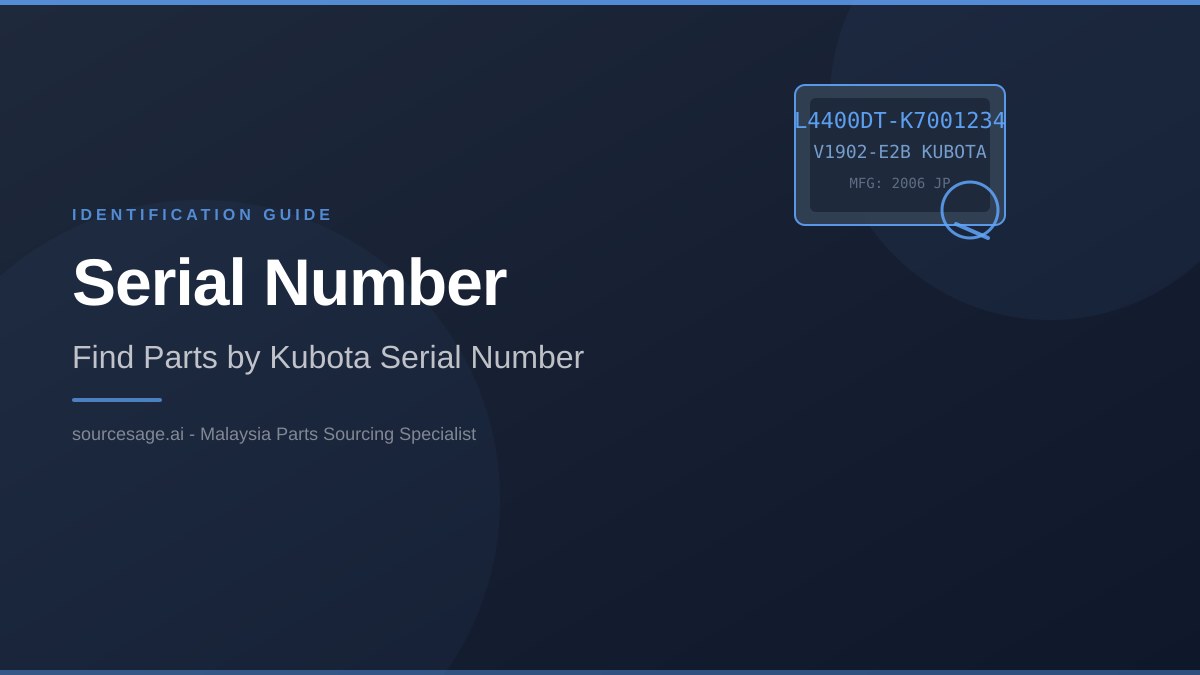
The serial number plate is gone. Or it's there but the digits are worn smooth. Or someone has spray-painted over it at some point in the tractor's 20-year history. It happens all the time with older equipment, and it leaves owners stuck: how do you order parts for a tractor you can't definitively name?
Here's the thing — a Kubota serial number alone contains enough information to identify the model and source the right parts. You just need to know how to read it.
Where to Find the Serial Number
The serial number is almost always separate from the model plate, and it's typically stamped directly into metal rather than printed on a label — which is why it survives long after the stick-on label is gone.
For L-series tractors (L2900, L3000, L3200, L3400, L3408, L3608, L3800, L4400, L4740, etc.): The serial number is usually stamped on the left side of the main frame, just below the operator platform, or on a pad near the front axle.
For M-series tractors (M5700, M6000, M6800, M9000, M9540, M6040, M8540, M108S, etc.): Look on the right side of the transmission case or on a pad near the rear PTO housing. The stamp is often recessed and may need cleaning to read.
For B-series tractors (B2320, B2920, B3200, B5200, B6100, etc.): Usually on the front of the main frame near the front axle, or on the underside of the bonnet near the engine.
Reading the Kubota Serial Number
A typical Kubota serial number looks like this:
L4400D-XXXXXX
The first part — before the dash — is the model code. Even if you don't know what the model code means, you can use this alone to look up parts.
If the serial number plate shows only numbers (no model code prefix), the format is:
XXXXXX — typically a 5-7 digit number where the first two digits indicate the production year.
For example, a serial number starting with 50 was likely produced in the mid-2000s on most Kubota L-series production schedules. This doesn't pin down the model perfectly, but combined with the physical characteristics of the tractor, it narrows the field significantly.
What You Can Do With a Serial Number Alone
Step 1: Contact Kubota Malaysia (for recent models)
If your tractor was built after approximately 2005, Kubota Malaysia's authorised dealers can look up the production record using the serial number. This gives you the exact model, specification, and country-of-supply record.
This only works for units within the last 20 years or so — older records may not be in the electronic system.
Step 2: Use the Engine Serial Number Instead
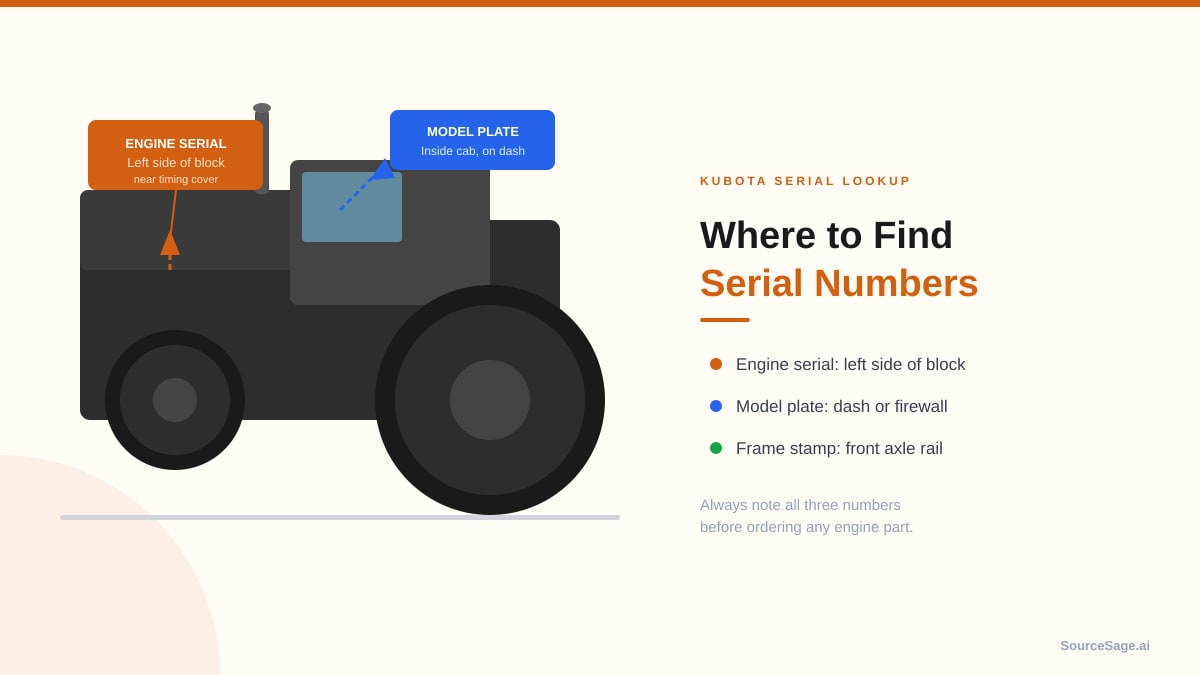
The engine serial number is separate from the chassis serial and is often more durable. It's stamped directly into the engine block — usually on the top or right-hand side near the valve cover.
The format is typically: [engine model]-[serial number]
Example: V2403-123456
With the engine model code (V2403 in this example), you can:
- Identify all tractor models that used this engine
- Source engine parts with certainty (seals, gaskets, injectors, belts)
- Narrow down the tractor model to 2–4 candidates
Common V-series engine codes and the tractors they're found in:
|| Engine | Kubota Tractor Models | ||-------|--------| || V1505 | B3030, B3300, B3200 | || V1903 | L3430, L3540, MX4700 | || V2203 | L3000 (some), L3130 | || V2403-M | L3800, L4400, L4200, some L4740 | || V3300-TIE | M9000 | || V3800-DI-T | M9540DT (newer), M8540 | || V6108 | M108S, M110GX |
Step 3: Use Physical Characteristics to Confirm
Once you've narrowed it to two or three candidate models, physical measurements confirm the match:
- Wheelbase: Measure from front axle centre to rear axle centre. This is consistent and a reliable identifier.
- Engine displacement: If you have a compression tester and can count cylinders, displacement gives you the engine family.
- Transmission type: Count the number of speeds available. An 8-speed = different model than a 16-speed.
- PTO speed: Stamp on the PTO shaft housing usually says 540rpm or 540/1000rpm.
What We Do When a Customer Can't Identify Their Model
If someone contacts us with "I have an old Kubota, don't know the model, need parts for X" — here's the identification process we follow:
-
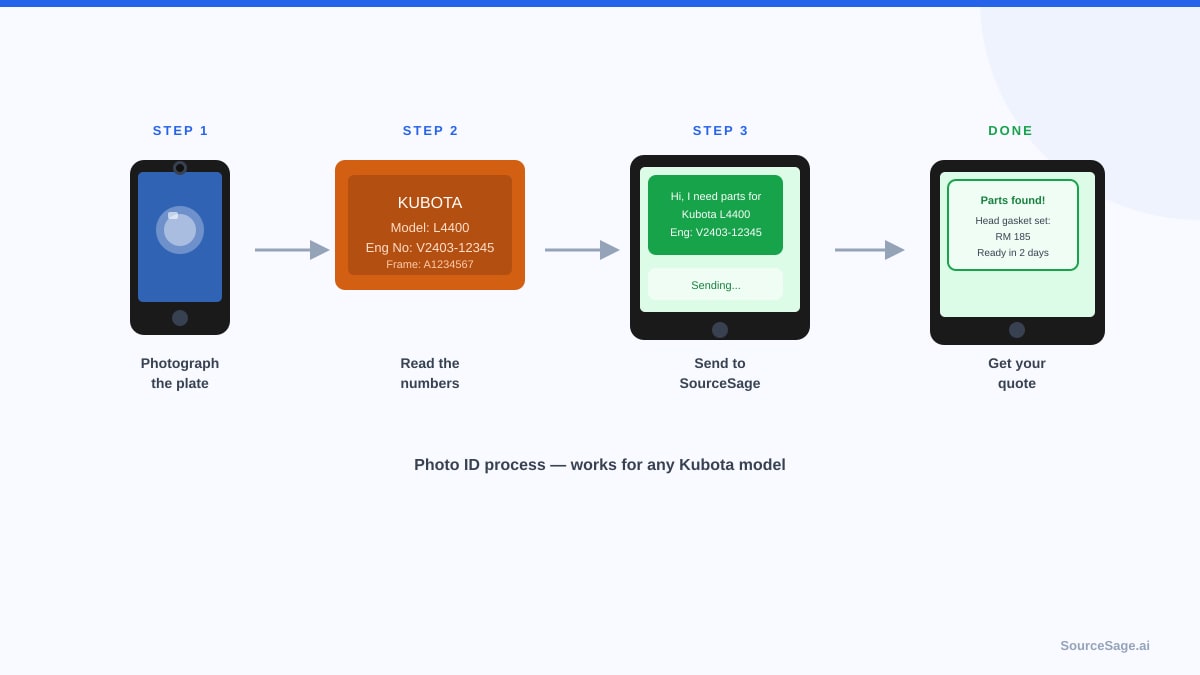
Ask for photos. Left side of the tractor frame, right side of the transmission/rear, engine serial number pad, and overall front and rear views. Four photos, taken while standing back about 3 metres.
-
Check the engine serial. This alone usually confirms the engine family and narrows candidates to 2–3 models.
-
Cross-reference the reported symptom to the suspect models. If the customer says "the hydraulic won't lift," the hydraulic system type (open-centre vs closed-centre) differs across models and helps confirm which one we're dealing with.
-
Propose two or three matching part numbers and confirm against a photo of the failed part. If all three candidates use the same part (which happens often with Kubota's cross-model platform approach), we can ship with confidence regardless of which exact model it is.
-
Ship. For genuine Kubota parts, we usually confirm within 1 business day. For aftermarket or Japan-sourced parts on hard-to-identify older models, we may need 2–3 business days to confirm availability before quoting.
The Part You Think You Need vs The Part You Actually Need
One more thing worth saying: it's common for a specific part name to come to mind — "I need a new hydraulic pump" or "I need injectors." Half the time, the actual diagnosis is something different and cheaper.
Before ordering major components, tell us the symptom, not the conclusion. "Hydraulic lift is slow and won't hold weight" often turns out to be a seal kit fix, not a pump replacement. "Black smoke and poor power" is usually a blocked air filter or a single injector, not a full set.
We'll ask the diagnostic questions. You'll get the right part the first time rather than spending on something that doesn't solve the problem.